 Contents
- What Is a Magnetic Field?
- Technologies That Use Magnetic Fields
- Medical Industry: MRI (Magnetic Resonance Imaging) Systems
- Semiconductor Industry: Electron Beam Lithography Systems
- Requirements for Machine Components in Magnetic Field Environments
- Low Magnetic Permeability Linear Motion Guide Model HSR-M3
The rapid advancement of technology in recent years has driven the development of many new applications involving magnetic fields across a wide range of industries, from medical equipment such as MRI systems to semiconductor technologies like electron beam lithography systems.
In this article, we will explore the key performance requirements for linear motion components operating in magnetic field environments. Temas will also introduce a low magnetic permeability linear motion guide designed specifically for these demanding applications.
What Is a Magnetic Field?
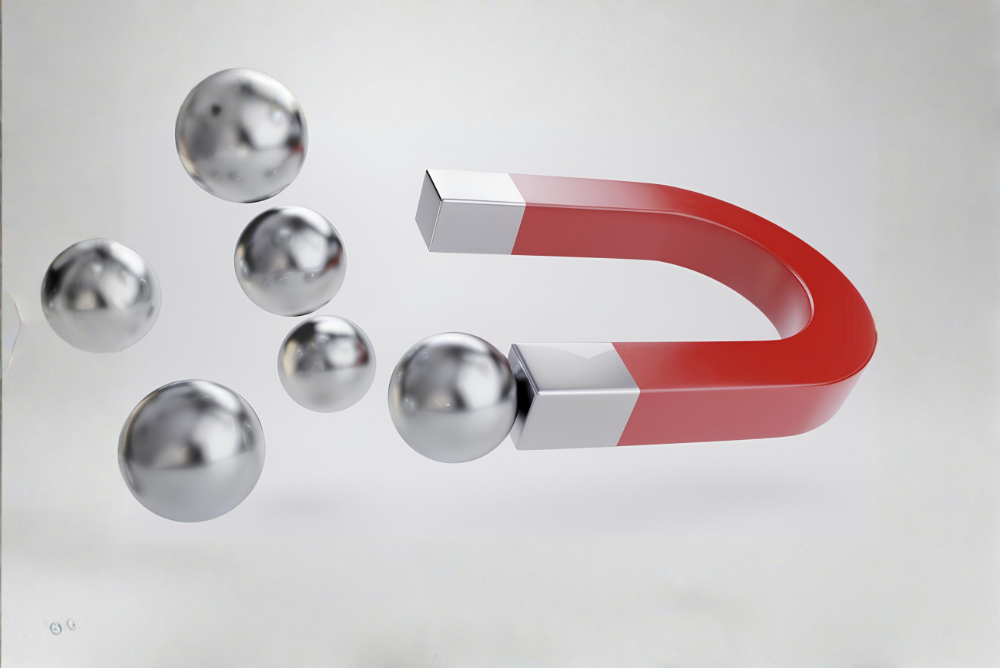
So, what exactly is a magnetic field? Magnets and electric currents generate a force known as magnetism. This force surrounds the magnet and can attract or repel certain types of metals. The space in which this magnetic force exists is called a magnetic field. You may remember experimenting with magnets as a child by bringing them close to different objects. Most metallic objects are attracted to magnets. Some materials, such as paper clips, can even become “magnetized” after being exposed to a magnet for a sufficient period of time, allowing them to attract other paper clips even after the magnet has been removed.
Materials that can be strongly magnetized in this way are known as ferromagnetic materials. One of the most familiar examples is iron.

Technologies That Use Magnetic Fields
Iron is inexpensive, easy to process, and widely used in countless industrial and everyday applications. However, there are environments where magnetic materials such as iron are completely unsuitable.
Medical Industry: MRI (Magnetic Resonance Imaging) Systems
MRI systems are one of the most well-known examples. During scanning, these machines generate extremely strong magnetic fields to create detailed images of the human body. Because MRI systems essentially function as giant magnets, they can attract ferromagnetic materials with dangerous force. For this reason, patients must remove all metallic objects before entering the MRI room. In addition, equipment installed near MRI systems must be manufactured from materials that are minimally affected by magnetic fields.

Semiconductor Industry: Electron Beam Lithography Systems
Ferromagnetic materials are also unsuitable for electron beam lithography systems, a critical technology used in semiconductor manufacturing. These systems use electron beams to draw highly precise electronic circuits, with modern technologies capable of achieving circuit line widths as small as 2 nm.
However, even extremely small amounts of surrounding magnetism can deflect the electron beam and compromise pattern accuracy. As a result, these systems require components made from non-magnetic or ultra-low magnetic materials.

Requirements for Machine Components in Magnetic Field Environments
Relative magnetic permeability is the standard index used to measure how strongly a material is affected by magnetic fields. It is defined as the ratio between the material’s magnetic permeability and that of a vacuum. The closer the value is to 1, the less the material is influenced by magnetic fields. In comparison, conventional iron-based materials commonly used in machine construction typically have relative magnetic permeability values ranging from 50 to 5,000.
Depending on the application, low magnetic permeability may be an essential requirement, especially in systems such as MRI equipment and electron beam lithography machines. However, low magnetic permeability alone is not enough. For example, a surface hardness of approximately HRC 60 is generally considered suitable for machine components. Meanwhile, low-permeability materials such as SUS316 only achieve a surface hardness of around HRC 30, which is relatively low. This limits their performance and service life when used in machine mechanisms.
In other words, conventional materials often require a trade-off between low magnetic permeability and high surface hardness. So how can machine components maintain both low magnetic permeability and high hardness, especially when the base material is primarily iron?
Low Magnetic Permeability Linear Motion Guide Model HSR-M3
To address this challenge, the low magnetic permeability Linear Motion Guide Model HSR-M3 was developed. It is specifically designed to resist the effects of magnetic fields, making it suitable for MRI systems, inspection equipment, and other applications exposed to strong magnetic environments.

The most notable feature of this product is its extremely low magnetic permeability. Thanks to its specially developed material, the Model HSR-M3 achieves a relative magnetic permeability of only approximately 1.02. With both the guide rail and LM block manufactured from this material, the system can maintain maximum performance even in magnetic field environments, significantly simplifying the machine design process.
In addition, the material used in the Model HSR-M3 achieves a surface hardness of approximately HRC 40, which is higher than many other low-permeability materials. This improves the load capacity of the Linear Motion Guide and provides greater design flexibility, such as allowing the load center of gravity to be positioned farther from the guide while still maintaining stable operation.

The Model HSR-M3 belongs to the HSR series, one of THK’s long-established Linear Motion Guide product lines widely used around the world. The product complies with ISO dimensional standards while inheriting key performance features such as self-aligning capability for absorbing mounting errors and equal load ratings in all four directions, enabling flexible installation orientations.
As a result, the product can be integrated into existing systems without requiring major design modifications.
Previously, low magnetic permeability guides were typically manufactured only as custom-made products. However, the Model HSR-M3 is now available as a standard catalog product, allowing users to significantly reduce product selection and procurement time.
This article has explored the technical requirements for linear motion components operating in magnetic field environments while introducing the low magnetic permeability Linear Motion Guide Model HSR-M3 as an effective solution. As equipment performance and precision requirements continue to increase, the demand for low magnetic permeability products is expected to grow even further.
Temas is an authorized distributor of THK products in Vietnam, supplying a wide range of Linear Motion Guides for automation and machine-building applications. With a team of experienced engineers, Temas is ready to provide technical consultation, assist with product selection, and support customers throughout the entire implementation process. Contact Temas today for detailed technical advice and the most optimized solution for your system.



 Read more